Tuesday, March 8, 2011

The Gift of Seeing

Lady's Slipper Orchid
Cypripedium guttatum
Unalaska Island

There seems to be a perverted connection in our new world culture between "busyness" and "happiness."  We link "frenzy" with "success," filling our days churning out proliferating quantities of activity - all in a frantic pursuit of that illusive horizon.  We're upset if the commuter in front of us is traveling too slow; it interferes with our "production."  Our lives become one endless train of events, each one simply a link to the next, our steps becoming a never ending chain stretching into our future with the fading hope of one day obtaining a reward.


 Grave markers, Dutch Harbor
I think that is why sailing as well as working with traditional hand tools can become so appealing.  They both offer a forced curriculum where the participant can learn a new perception of time - a lesson where finally the eyes and heart can be opened to the moment.   Robert Cushman Murphy, a naturalist aboard a whaling ship in the early 1900's, writes sympathetically about this lack of seeing among his fellow crewmen while becalmed in the Sargasso Sea: 

"Why, after all, should these equatorial children take delight in the experiences that will somehow carry me through until you and I are once again together?  Their comfort is far less than mine, their work more arduous, their privacy nil.  In the face of unfamiliar food, they remember only their palmiest days ashore.  Hope of money, all too likely to dim with experience, is their sole lure.  Their thoughts and desires are centered on whales - whales and a port.  They follow the calling not for its own sake, but only for what it may bring - the lay, one-hundredth, one hundred-and-fiftieth, one two-hundredth, or whatever the humble cut may be.  They are poor observers of things in general.  Living creatures interest them when they can eat them or boil them down to oil, but they are as unconcerned with the dazzling plunge of a tropic-bird as with the glowing, luminescent waters of a Caribbean evening.  Sunsets, and the constellations of night skies, they do not appear to see.  Perhaps their first thought of a star will come when the Daisy, her hold filled, turns her bow away from the southern ocean.  Then we shall all be gazing nightly toward the line until changeless Polaris pops up to guide us home."  (p. 11, Logbook for Grace,Time Life books, 1947)

Petersburg, Alaska

The subtle difference between Murphy and his shipmates is in the emphasis of what the moment could do to them instead of what it could do for them.  Quietness and solitude have very little to offer the mind seeking another notch in the belt of individual profiteering, but the heart longing to be changed will find the moment of stillness invaluable.
Midnight Sun Cafe, Anchorage

Because the true reward is always before us now, not in tomorrow.

Thursday, March 3, 2011

An Alaskan Life

There is something intensely gratifying in having your days begin with a cup of coffee next to a wood stove that is quietly radiating a soothing calmness into your soul.  It's a quiet time of reflection, introspection, and contentment as the sun lightens the stunning vistas across the valley.  The uniqueness and the quietness of Alaska is utterly breathtaking.  And it is those qualities that bring me to fall in love with the state over and over again.

We sailed into Alaska on June 20, 2005 arriving in Ketchikan at 1530 local time.  The Dixon Entrance crossing had been uneventful; relatively calm with only some leftover north-westerly swell from the low pressure system that had earlier swept through the area.  Little did we know then that we were standing at the doorstep of a lover that would woo our hearts for years to come.

It's easy to understand why we would become so captivated by Alaska.   With 34,000 miles of shoreline (some are now estimating that with more accurate GPS mapping the total is closer to 44,000 miles), it's easy to become lost in a world where only you and beauty exist.  The entire state records a population of less than 700,000 people - and almost half of those live in Anchorage, the largest city situated at the head of Cook Inlet.  This is for a state that covers almost 600,000 square miles -  almost three times the size of Texas, or one-fifth the size of the contiguous United States.  In other words, there's a lot of open country with very few people. 

It would only be natural that such a unique state would foster a different slant on what life looks like.  You can find many examples of where value is measured by what you can do for yourself - necessarily so.  It is estimated that there are six times as many pilots per capita as anywhere else in the United States and 16 times as many airplanes.  That equates to roughly one pilot with aircraft for every 61 Alaskans.  Dog teams are still actively a part of the winter landscape - and not only during the Iditarod festivities.  Denali National Park uses the only sled dogs in the United States to patrol a national park during the winter months, logging an average of 3000 miles every year since 1921.  Dutch Harbor is home to an enormous fishing industry where the next largest, Louisiana, is a very distant second with one quarter of its volume for seafood landings.  In 1991 Dutch Harbor offloaded "in excess" of 731.9 million pounds of seafood - and Unisea, one of four large processors on the island, is capable of processing over 130,000 lbs of seafood per hour at it's peak capacity.

The statistics simply continue to baffle the mind.

More than 3,500 bald eagles gather every fall along the Chilkat River near Haines to feast on salmon.  Over 20 million shorebirds pass through the Copper River Delta near Cordova every spring.  The rufus humingbird finds Alaska its destination on its 2000 mile migration every year.  Warblers travel over 6000 miles to arrive in Alaska from the jungles of South America.  Pacific golden plovers arrive from Hawaii and Polynesia, and Arctic terns that have been observed wintering in the Antarctic regularly nest in the Alaskan arctic, an annual 20,000 mile round trip.  The state also records almost one million caribou, thousands of muskox, and hundreds of thousands of bear, moose and deer.  It has recorded three of the largest top ten earthquakes in the world, two of which were in the top three.  It has over forty active volcanoes.  Over 5000 glaciers.  Three million lakes over 20 acres in size.  And when the sun rises in Barrow on May 10th of every year, it won't set again for nearly three months.

It's no wonder the views continue to swell my heart and soul every morning.  Sometimes it seems too much to take in.

My only regret is that Canada didn't have a spare 7.2 million kicking around on March 30, 1867.

statistics taken from http://sled.alaska.edu/akfaq/aksuper.html, http://www.unisea.com/seafood_production.htm, http://www.naturephotographers.net/articles0106/bt0106-1.html

Friday, February 25, 2011

The "Task Within the Task"

I recently read a short meditation from Fr. Rohr at the Center for Action and Contemplation.  In it he explains the journey of finding our purpose in life.  He explains;

"There is much evidence that there are at least two major tasks to human life.  The first task is to build a strong container or identity; the second is to find the contents that the container is meant to hold.  We all try to do what seems like the task that life first hands us: establishing an identity, a home, relationships, friends, community, security, and building a proper platform for our only life.


But it takes us much longer to discover the 'task within the task,' as I like to call it: what we are really doing when we are doing what we are doing."

It seems to me that he is saying that it is not only crucial to build a good box, but to also contemplate what we are filling it with.

Spalted birch, tung oil, paste wax finish.  Anniversary message written by woodburning on underside of lid.

Wednesday, February 16, 2011

The Ability to Bend

Charles Darwin is often quoted (and some would say, misquoted) to have said, "It is not the strongest of the species that survive, nor the most intelligent, but the one most responsive to change."

That came to mind this week as I was trying to fashion a handle for my wooden bucket that  is part of a group project posted on the LumberJock website.  

Four times I tried to coax a narrow strip of spalted birch into a nice, round half circle; by soaking it overnight, by steam bending, by hot pipe bending - all with the same result.  I'd get a few degrees of deflection and snap!  I'd be holding two separate pieces in my hand.  It was getting discouraging to say the least.

I decided it just wasn't going to happen, so I changed tactics.  Finding a clear, 2 inch diameter section of willow from the trimmings pile under a snowbank outside, I headed for my band saw.  Minutes later I had several nice, flat, 3/8 inch strips in my hand.  After placing the kettle on the stove, I fashioned a short tube to act as my steam chamber.  Ten minutes after the steam started to flow the willow was as compliant as my children are when promised an evening at the movies.
 
So what made the difference?  I'm sure there is a scientific explanation that in some way involves lignin and white rot fungi which would take way too much effort for me to uncover, so I'm happy with the obvious.  

The strip of birch didn't want to bend.  It liked things just like they were.  After all, that's how it was made to be, had always been that way, and would change over its dead body!  So with all the resistance it could muster, it balked all my pressures to bend and as a result ended up broken and discarded.  

Oh, to just have the courage to change.


Saturday, February 5, 2011

Finding the Dōgu - the Way of Tools

There is an online article written by Dave Lowry addressing the tools of the traditional Japanese craftsman.  In the article was a story of an old hermit woodcutter that died in the 1950's.  Among his possessions was found a yellowed slip of paper with the woodcutter's last wishes simply written down.  Dave recounts the hermit's desires for his most cherished tool:

"I have called this axe Hige-giri ('Beard-cutter')," read the paper. "I hope, when I die, it will be loved and used by one who truly appreciates its qualities." The note concluded, "I have nothing in life worth a thing except for this excellent axe. But then again, with an axe such as this, how much in life does one need?"

There is a strong connection in the traditional Japanese culture between the shokunin, or master craftsman, his tools, and his work.  And through his work he is strongly connected with his community. Toshio Ōdate describes it this way:

"The shokunin has a social obligation to work his best for the general welfare of the people.  This obligation is both spiritual and material, in that no matter what it is, if society requires it, the shokunin's responsibility is to fulfill the requirement.  The relationship of a shokunin to his tools is therefore very close, for it is through the tools that the work of the shokunin is created.  Each of the shokunin's tools is his life and pride." (Introduction, "Japanese Woodworking Tools: Their Tradition, Spirit, and Use" The Taunton Press, 1984)

There is a profound lesson in simplicity, contentment, and humility in considering the life of the shokunin.  It is a value sadly lacking in our industrially bred, consumer fed society, and I would suggest we all suffer because of it.

Wednesday, February 2, 2011

Pursuing Beauty in the Shop

The late Saul Bass, an accomplished and recognized graphics designer, said in an interview in 1987:

"Aesthetics are your problem and mine; nobody else's.  The fact of the matter is, I want everything that we do, that I do personally, that our office does, to be beautiful.  I don't give a damn whether the client understands that that's worth anything, or that the client thinks it's worth anything, or whether it is worth anything; it's worth it to me.  It's the way I want to live my life.  I want to make beautiful things, even if nobody cares."

I've been "noodling" and "futzing" with a wooden plane I've been building for the past few weeks, and am now searching for an acceptable plane iron for it.  It's been a fun project, and it's all part of a wooden bucket blog on the Lumberjocks website.  The carvings are my attempt at acanthus leaves, a very common detail in early Greek architecture, traditionally used to symbolize enduring life or immortality.  The scrolling form of the acanthus leaf has become a very popular decorative feature in wood carving and one I've been anxious to try, and this was a perfect opportunity to bring something a little extra to an otherwise simple project.

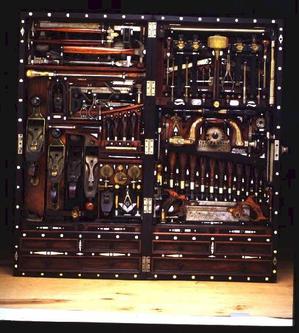
The tradition of decorating hand tools is something that has been sadly lost to our generation but was very common in the earlier centuries.  Often the workman's tools as well as his tool chest was considered to be a testament to his craft and proudly displayed as his ability to create beauty in his work.  One famous example of this is the amazing tool chest of Henry O. Studley (1838 - 1925), a piano and organ maker that worked for the Poole Piano Company in Boston, Massachusetts that is currently part of the "Tool Chests, Symbol and Servant" display at the Smithsonian National Museum of American History in Washington DC.  It held an estimated 300 tools and is an incredible display of his pride in fine workmanship and quality. This would have fit well with the philosophy of Bass, as the appreciation of beauty is clearly present, regardless if the client had any appreciation for it or not. 

My attempts of individuality through the pursuit of beauty is nothing compared to the caliber of Mr. H. O. Studley, but a little of the pleasure and commitment is still there.  And as someone once said,

"Working with a beautiful tool is like dancing with a beautiful woman - it doesn't help you dance any better, but it sure is a lot more fun."

And to me, this new plane will become a beautiful dancer indeed.

Tuesday, February 1, 2011

Projects Outside the Workshop

One of the lingering benefits from our sailing experience has been the appreciation and satisfaction that comes from being self sufficient.  Our boat was completely able to operate "off the grid" and many weeks could pass before we would need to find a port to re-provision with supplies or water.  We would supplement our supplies with fishing and berries while in remote areas, and simple repairs were done with supplies on hand.  Major failures were either "jury rigged" or done without until proper repairs could be made in port.  This independent style of living brought a lot of satisfaction in the knowledge that we could look after ourselves.


This desire for self sufficiency continues to impact how I continue to live on land and that feeling of independence is a major part of the satisfaction I enjoy when completing a project.  Not everything I need requires a trip to the store - often the materials are readily available and simple - and the supplies we do purchase tend to be more of the basics and less of the processed or finished product.  This last weekend was no exception - and the satisfaction just as real as any project I've churned out in the workshop - even though this one came from the kitchen.

My grandmother is reputed to have said that "no-one will ever starve as long as they keep a sack of beans stored in the attic."  Whether she actually did keep any stashed away is unknown, but her words ring true.  Simple provisions - rice, beans, TVP, flour - can provide the basics for many meals and are easily stored for long periods provided they remain dry.  This weekend's project was tackling one of those provisions; one we enjoy keeping stocked in our "attic."

The recipe I use is adapted from Mennonite's Country-Style Recipes by Esther H. Shank (Harold Press, 1987):

8 cups beans, soaked overnight and cooked for 1 hr in same water, drained, reserving liquid
1 lb bacon, cut into small pieces
2 onions, chopped
1 cup brown sugar
3 cups ketchup
1/2 cup molasses
4 Tbsp prepared mustard
4 tsp salt
1 tsp cinnamon
1/2 tsp ground black pepper

Mix well along with 4 cups of the reserved bean liquid, fill pint jars and process in pressure canner 75 min at 10 lbs pressure.


There's just something extremely satisfying with a well stocked shelf filled with jars you've prepared yourself.

Even if it did happen in the kitchen.