Showing posts with label tools. Show all posts

Thursday, March 15, 2012

A choice of power

Frederick Buechner writes in "The Magnificent Defeat"

"I suppose we might begin by saying that man's absolute power, the one that he can be surest of because it involves nothing except power, is his power to destroy.  One does not need talent or brains to destroy.  Anybody can do it: can destroy an animal, a bird, an object, an enemy or friend, himself, Jesus Christ.  There is no need to add that as matters stand now man has the power even to destroy mankind.  However, that is only half the picture because in addition to his power to destroy, man also has the power to create.  We can make things: paintings and political systems, theological systems, supersonic aircraft, iron lungs." (p. 32 HarperCollins, 1966)

Those words came to mind as I was discussing with my sister, Edith, about inspirational carvings I could use on my sawbench that I was completing.

I ended up choosing two simple phrases, "to destroy" and "to create."


She suggested using traditional Hebrew, "shabar" and "bara'."


I loved it.

It's something I'd like to remember every time I sit down at this bench.


For my hands are capable of either.


Tuesday, July 19, 2011

It all starts (and ends) with the teeth

I've started a new project in the shop.  It's been nice to have the use of a workbench and garage while we were staying in this house, but since our time in Anchorage is coming to a close and we have no firm destination in view after we leave the city, I began to explore ideas for a bench that could be fairly compact; part storage, part work area, part saw bench.....

Ideas come prolifically once you start looking.  And the final push popped into place when I saw Ron Herman's sawbench in the August issue of Popular Woodworking magazine.  A sawbench you could sit on, carve on, saw on, build on.... it wasn't a long leap from there and my new mini bench was born.


Of course, new projects are always worth diversions into unfamiliar territory and it's the first time I threw the ruler away and simply drew the plans with a pair of dividers.  Using 3:5 and 1:3 ratios I worked up something I liked and managed to incorporate a till into the top for my saws.  And with the addition of a few holes in the sides and top, I might even manage to sneak a few dogs and holdfasts in there as well.  Using my kneecap measurement for the height, I soon had all the calculations plugged into place for a materials list. 


After a trip to the box store for some 2X4X96 fir the work began in earnest.  I would like to build this one as simply and traditionally as possible, and will be planing 1 inch stock to edge glue for the sides and ripping 1/2 inch stuff for the till.  The laminated part of the bench beside the till will be 1.5 X 3 inch sections face glued to add a little heft to the top.

Digging up an old handsaw that has rattled in my toolbox for years then got me struggling with the obscure notions of fleam, rake and set.  It's an old saw, and I definitely need the practice learning to sharpen one.


Monday, June 13, 2011

A Knife for a Gift

This morning I decided it was high time to get myself back into the shop and let my hands get dirty again.  Lately my mind has been doing all the flexing and stretching, and it needs a break.

My sister is planning a visit to Alaska and has expressed some interest in trying her hand at carving while she is with us.  I'm certainly not a qualified teacher, but I am more than willing to assist her in whatever way I can to see what we can create together.  In that regards, while standing at my workbench and staring at a block of wood and a broken sawsall blade, I decided to make her a knife in anticipation of her arrival.


The block was an old piece of cedar and plywood, glued together for some other forgotten project, and looked like it might just fit the bill for a unique handle.


The grinder handled the bulk of shaping the blade, ensuring it kept cool by repeatedly dipping it in water so the temper wasn't lost.


A brief stop at the band saw and the pieces were ready for gluing.


Some sanding and woodburning and the knife was ready for finish.  A brass rod for the rivet and it was ready to hone.


Stropped and razor sharp it will now wait until Edith arrives and claims her new tool.  It's been a good day; I not only enjoyed being back at the bench, but I also hope my handiwork will bring a little pleasure to whatever she chooses to use it for in the future.

Cedar, Okume 4mm ply, tung oil, clear shellac and wax finish

Tuesday, May 17, 2011

Must Take All

In the home where we have been staying, the phone line and internet connection has been essentially disabled for the past week.  There is such severe interference on the line that voice communication is almost impossible.  The response from a service desk personnel to one of my calls for repair could have been amusing if it hadn't been so frustrating:

"I can hear someone is there but I can't understand what you're saying!"


The phone line needs repair, you goof.


Unfortunately, Alaska Communications Systems, the provider for both our phone line and internet, has a Policy that the account holder, and only the account holder, can order repair work before they can issue a service ticket.


Unfortunately, the account holder is on a boat anchored outside of Puerto Williams, a small isolated city of roughly 2000 people on the Beagle Canal in the far southern tip of Chile.


Unfortunately, the satellite phone the account holder carries for emergency communication ends up dropping the call before the interminable maze of routing messages and holds can be navigated in reaching the ACS service desk.


Unfortunately, the email capability the account holder has through their single sideband radio on their boat isn't acceptable to ACS because it doesn't originate from one of the two email accounts they have on file for the account holder, even though it clearly states and identifies the account holder and that they wish to have the phone line fixed.


It's one of those policies with a huge, bold, capital "P."

To be fair, I suspect the competent folk at the ACS service desk are aware of that.  In my last conversation with them they were actually quite apologetic and conciliatory - he kept answering my questions with the disclaimer: "What I have been told by our business office is..."


In other words, please don't shoot the messenger.

Days like these aren't easy nor fun.  But life's like that.  One day you might find a great treasure at a garage sale, then the next day all you can do is build the box that will help you hold and remember it.


And you must take all.

Western Red Cedar, Tung oil finish

Friday, May 13, 2011

Boneshakers

Theresa has been starting to ride her bicycle daily to work which I think is quite an accomplishment.  It's a 25 mile round trip, and the benefits she gains with the drop of elevation in the morning is paid dearly on her uphill climb home.  It's a testament to her endurance and inner strength that she continues to leave each morning, pushing her bike out of the garage with panniers stuffed with her lunch, change of clothes, and books.

Bikes are modes of transportation that have been around for quite some time.  About.com records the earliest form of two wheeled transportation to be

"in 1790 by Comte Mede de Sivrac of France. Called a celerifere, it was a wooden scooter-like device with no pedals or steering."

From there we gained the velocipede, the penny farthing, and pneumatic tires by 1888.  Today bicycles have advanced to include all kinds of exotic components and carbon fiber.  Take a tour of your local bike shop - the sticker shock will reveal just how far this technology has come.


But our bikes are old.  We love them, and they have seen a lot of miles.  Both are Gary Fishers of mid 90's vintage that, along with all of the local use, have taken us on two self supported tours through the southern mountains of British Columbia; a road tour of Highway 1 between Calgary and Vancouver, followed two years later by the abandoned and scenic Kettle Valley Railway between Castlegar and Hope.  

And they've been abused.  For the last eight years they've seen a lot of their life strapped to the lifelines of our sailboat.  They've hauled propane, groceries and kids with the help of a Chariot double trailer and navigated the trails and loops of Unalaska Island in the Aleutians.


It's not surprising they're showing wear and tear.  It was high time for some sorely needed attention.

I began by digging through my toolbox and locating my bicycle toolkit.  Bicycle maintenance is an interesting diversion from the standard fasteners, with toothed sockets and slim metric wrenches becoming the requirement.  Stripping them down revealed a few dry bearings and pitted races in the drivetrain.  New pedals, chain, and a bottom bracket cartridge soon had the wheels spinning again like new.


But the hills still hurt.  Too bad our old muscles and bones can't be resurrected as easily as our bikes.  But with the gas prices climbing ever higher and higher, that too may be overcome by the end of summer.

Tuesday, April 26, 2011

A Morning with Morrie

Morrie Schwartz, a professor of Sociology who passed away in 1995 of Amyotrophic Lateral Sclerosis is recorded to have said in his last days:

"We've got a form of brainwashing going on in our country.  Do you know how they brainwash people?  They repeat something over and over.  And that's what we do in this country.  Owning things is good.  More money is good.  More property is good.  More commercialism is good.  More is good.  More is good.  We repeat it - and have it repeated to us - over and over until nobody bothers to even think otherwise.  The average person is so fogged up by all this, he has no perspective on what's really important anymore.  Wherever I went in my life, I met people wanting to gobble up something new.  Gobble up a new car.  Gobble up a new piece of property.  Gobble up the latest toy.  And then they wanted to tell you about it.  'Guess what I got?  Guess what I got?'"  (p. 125 Tuesdays with Morrie, Mitch Albom. Doubleday 1997)

I am working outside swapping the tires on the car from the studded, winter tread to the summer.  It's a simple, physical process that involves removing the tire from the rim and remounting the other.  I could take the car into town and have a shop handle it, but it's one of those tasks I prefer to do myself and it allows me time to let the words of something I have read percolate into the crannies of my mind.  What has driven us to become a society of such gobblers?


I break the bead with an old farm jack.  Jacking against the bumper of an old Suburban adds enough weight to crush the tire, sliding the bead down the rim with a sudden whoosh.

Morrie continues with his line of thought.

"These people were so hungry for love that they were accepting substitutes.  They were embracing material things and expecting a sort of hug back.  But it never works.  You can't substitute material things for love or for gentleness or for tenderness or for a sense of comradship." (Ibid)


I pry the first bead over the rim with a flat tire iron.  I've seen my father do this many times, and in fact this is the same iron he used on the farm.  It is another one of his tools that I collected last summer when we cleaned out his shop and moved him into town.

"Money is not a substitute for tenderness, and power is not a substitute for tenderness.  I can tell you, as I'm sitting here dying, when you most need it, neither money nor power will give you the feeling you're looking for, no matter how much of them you have."  (Ibid)


I hammer the second bead off the rim, using the prybar as a lever to pressure the tire away from the lip.  A few blows from the hammer and the rim pops free.

"There's a big confusion in this country over what we want versus what we need.  You need food, you want a chocolate sundae.  You have to be honest with yourself.  You don't need  the latest sports car, you don't need the biggest house.  The truth is, you don't get satisfaction from those things.  You know what really gives you satisfaction?  Offering others what you have to give."  (Ibid, p 126)


The summer tire is mounted and I begin to inflate it with air.  The beads snap against the sides of the rim with sharp, metallic pops.

"I don't mean money.  I mean your time.  Your concern.  Your storytelling.  It's not so hard.  Devote yourself to loving others, devote yourself to your community around you, and devote yourself to creating something that gives you purpose and meaning.  You notice, there's nothing in there about salary.  Do the kinds of things that come from the heart.  When you do, you won't be dissatisfied, you won't be envious, you won't be longing for somebody else's things.  On the contrary, you'll be overwhelmed with what comes back."  (Ibid, p 127-128)

The tires are changed and mounted on the car and all that is left is to clean up.  My back feels a little sore but my heart is light.  Grabbing the last of the tools I walk into the garage and kick off my boots.

Who'd have thought I'd be doing church this morning.

Monday, April 18, 2011

Batons and Breast Drills

This past month I was involved in an interesting conversation with a sibling that explored the idea of what things we inherit from our forefathers and subsequently also pass along to our children.  The discussion may have overstepped some relational boundaries - it suddenly came to an abrupt end - but it did manage to start me thinking about what that inheritance is and what I wish it to look like. 

We can often be convincingly tempted to whitewash history with a rosy brush, especially when aging parents are involved.  And certainly there are many things that we do treasure when we look back on where we came from and what things got us to where we are today.  Traditions, values, religion - all can be important areas of development that we not only cherish, but also wish for our children to assimilate.  Colorful histories, memories of our parents' journeys and their stories all become important foundations to anchor our perceptions of who we are and where we are going.


But as with all things in life, there is always the detritus that must also be identified and sifted.  And that's where the lines begin to fade and we soon find ourselves alienated from each other with fuzzy boundaries on a scary battlefield filled with precipices and powder kegs.  Life is never simple.


So today I chose to focus on something that has tradition, history and inheritable value with complete confidence.  It will get me back onto some safe, solid ground.


It's a two speed breast drill that was probably my grandfather's, although I found it in among my father's tools.  I don't ever remember seeing anyone use it, and the only marking on it is "Jordan Germany."  Not much history can be found about this drill, although there is some information on Jordan Tools to be found here.  


Of course, it needs some work.  The jaw springs are completely messed up, and it's missing its auxillary handle.  But all in all it's in pretty good shape, and I'm excited to get it added to my tool inventory.

Because this is something that I think would be worth passing on to my kids.  And that I hope we can agree on.

Saturday, February 5, 2011

Finding the Dōgu - the Way of Tools

There is an online article written by Dave Lowry addressing the tools of the traditional Japanese craftsman.  In the article was a story of an old hermit woodcutter that died in the 1950's.  Among his possessions was found a yellowed slip of paper with the woodcutter's last wishes simply written down.  Dave recounts the hermit's desires for his most cherished tool:

"I have called this axe Hige-giri ('Beard-cutter')," read the paper. "I hope, when I die, it will be loved and used by one who truly appreciates its qualities." The note concluded, "I have nothing in life worth a thing except for this excellent axe. But then again, with an axe such as this, how much in life does one need?"

There is a strong connection in the traditional Japanese culture between the shokunin, or master craftsman, his tools, and his work.  And through his work he is strongly connected with his community. Toshio Ōdate describes it this way:

"The shokunin has a social obligation to work his best for the general welfare of the people.  This obligation is both spiritual and material, in that no matter what it is, if society requires it, the shokunin's responsibility is to fulfill the requirement.  The relationship of a shokunin to his tools is therefore very close, for it is through the tools that the work of the shokunin is created.  Each of the shokunin's tools is his life and pride." (Introduction, "Japanese Woodworking Tools: Their Tradition, Spirit, and Use" The Taunton Press, 1984)

There is a profound lesson in simplicity, contentment, and humility in considering the life of the shokunin.  It is a value sadly lacking in our industrially bred, consumer fed society, and I would suggest we all suffer because of it.

Wednesday, February 2, 2011

Pursuing Beauty in the Shop

The late Saul Bass, an accomplished and recognized graphics designer, said in an interview in 1987:

"Aesthetics are your problem and mine; nobody else's.  The fact of the matter is, I want everything that we do, that I do personally, that our office does, to be beautiful.  I don't give a damn whether the client understands that that's worth anything, or that the client thinks it's worth anything, or whether it is worth anything; it's worth it to me.  It's the way I want to live my life.  I want to make beautiful things, even if nobody cares."

I've been "noodling" and "futzing" with a wooden plane I've been building for the past few weeks, and am now searching for an acceptable plane iron for it.  It's been a fun project, and it's all part of a wooden bucket blog on the Lumberjocks website.  The carvings are my attempt at acanthus leaves, a very common detail in early Greek architecture, traditionally used to symbolize enduring life or immortality.  The scrolling form of the acanthus leaf has become a very popular decorative feature in wood carving and one I've been anxious to try, and this was a perfect opportunity to bring something a little extra to an otherwise simple project.

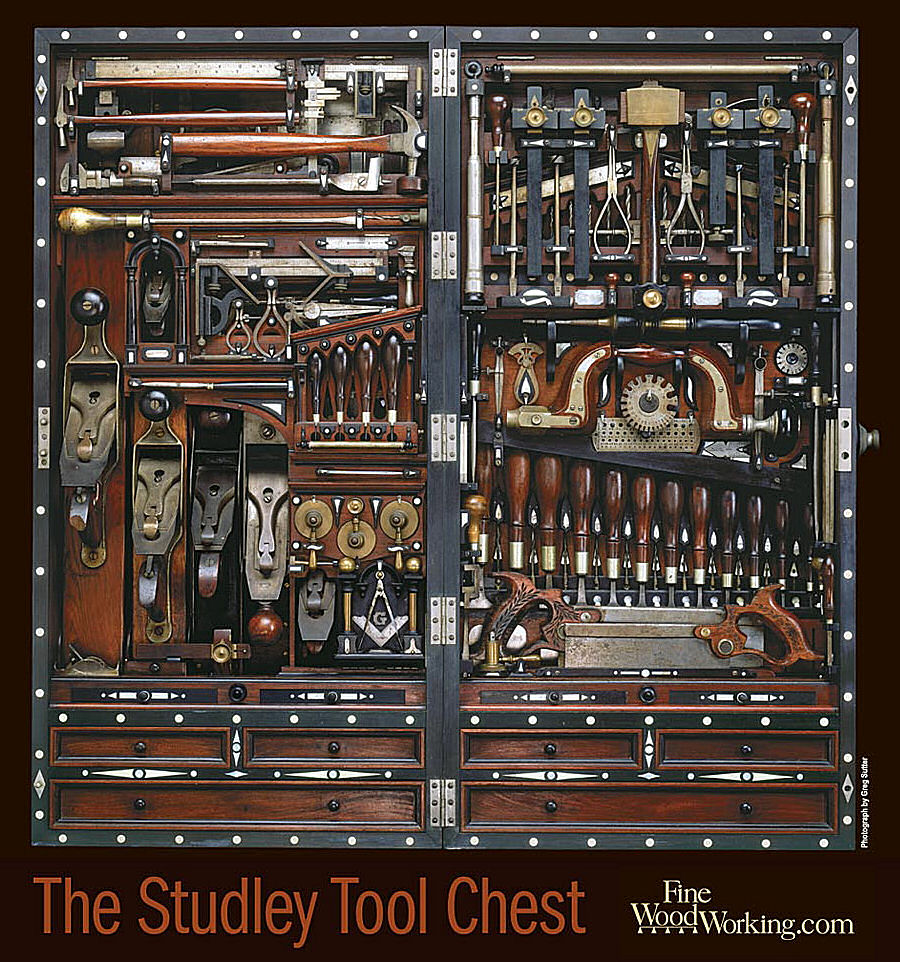
The tradition of decorating hand tools is something that has been sadly lost to our generation but was very common in the earlier centuries.  Often the workman's tools as well as his tool chest was considered to be a testament to his craft and proudly displayed as his ability to create beauty in his work.  One famous example of this is the amazing tool chest of Henry O. Studley (1838 - 1925), a piano and organ maker that worked for the Poole Piano Company in Boston, Massachusetts that is currently part of the "Tool Chests, Symbol and Servant" display at the Smithsonian National Museum of American History in Washington DC.  It held an estimated 300 tools and is an incredible display of his pride in fine workmanship and quality. This would have fit well with the philosophy of Bass, as the appreciation of beauty is clearly present, regardless if the client had any appreciation for it or not. 

My attempts of individuality through the pursuit of beauty is nothing compared to the caliber of Mr. H. O. Studley, but a little of the pleasure and commitment is still there.  And as someone once said,

"Working with a beautiful tool is like dancing with a beautiful woman - it doesn't help you dance any better, but it sure is a lot more fun."

And to me, this new plane will become a beautiful dancer indeed.

Saturday, December 11, 2010

The Union of Wood

The joining of two woods is a good thing. 

The individual grain of one will inevitably oppose the other, but by bonding together they discover stability and strength.  Along with another species of wood, they all form a partnership that becomes greater than simply the sum of the parts.  All the individual differences combine together to create one unique and beautiful addition to the other tools on the bench.


What could we as people also accomplish - locally and globally - if we would move beyond our fears and begin to celebrate our differences?

"Beware the man of one book."
 St Thomas Aquinas


French style marking gauge, jatoba head and wedge with oak beam.  Finish tung oil with clear shellac.

Plans and article from Popular Woodworking available here.